Three Names Recruiters Actually Trust: A Real Look at Google, Microsoft, and IBM's Free Certifications
Published on August 13, 2026
Blogs
A Real Look at Google, Microsoft, and IBM's Free Certifications
Walk into any placement cell conversation, and someone will eventually say, "Bro, get a free certificate and add it to your resume..." Nobody follows that up with which certificate, from where, or whether it'll mean anything to the person actually reading the resume. That gap is exactly why so many students collect five random certificates and still get the same silence back from recruiters.
Three names consistently cut through that noise — Google, Microsoft, and IBM. Not because their courses are flashier than everyone else's, but because recruiters have seen candidates come through with these specific certificates enough times to trust what they represent. This isn't a "here's a giant list" roundup. It's a closer look at what each of these three actually offers, which ones are worth your time, and how to make sure the certificate does more than sit unused on your LinkedIn.
Why These Three Companies Specifically
A certificate's value comes down to a simple question — does the person reading your resume already know and trust the name behind it? Google, Microsoft, and IBM clear that bar instantly, for slightly different reasons.
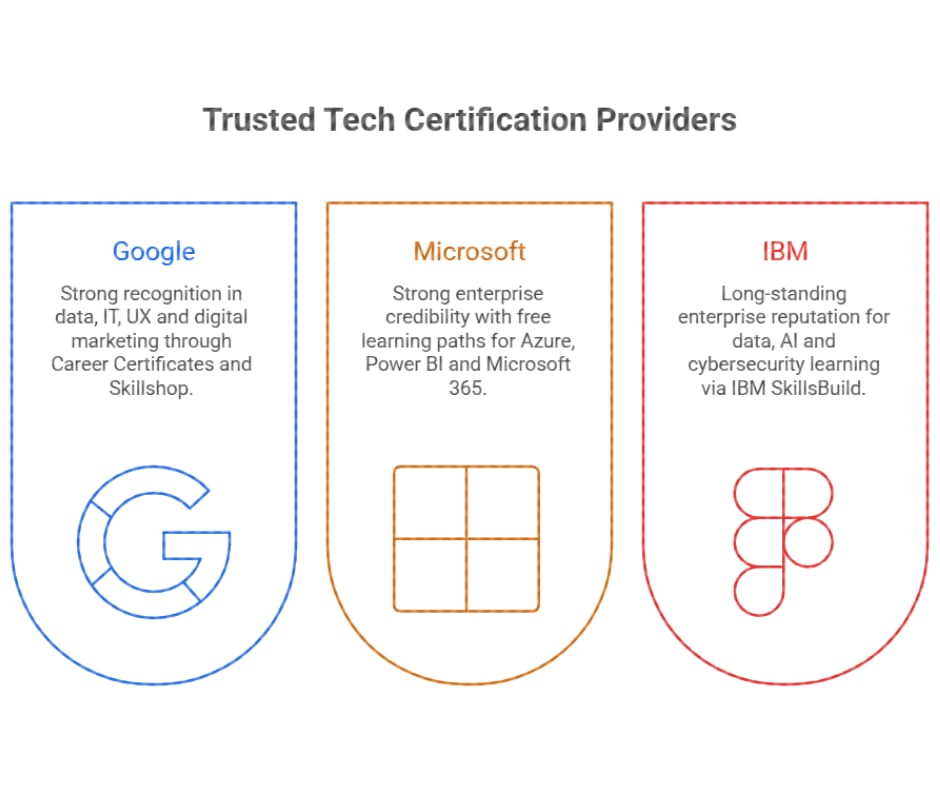
Google's weight comes from how directly its certificates map to real hiring needs — the company built these programs specifically because it kept struggling to find enough entry-level talent in data, IT, and UX, and several of its hiring partners genuinely treat completion as equivalent to relevant experience. Microsoft's credibility runs through the sheer number of companies already running on its tools — Azure, Power BI, Microsoft 365 — which means a Microsoft certificate signals you can work with systems a recruiter's own company likely already depends on. IBM leans on its long enterprise reputation, and its free learning platform has become a genuine entry point into data, AI, and cybersecurity roles at large corporate employers who trust the IBM name from decades of enterprise contracts.
Google's Free Certification Options Worth Knowing
Google Career Certificates cover IT Support, Data Analytics, UX Design, Digital Marketing, and Project Management, all hosted on Coursera. The full certificate track with graded assignments does carry a cost, but auditing the course content — watching every lecture and completing every practice exercise without paying for the graded assessment — is entirely free and teaches the actual skill just as thoroughly.
The IT Support certificate suits complete beginners well, covering troubleshooting, networking basics, and system administration fundamentals that lead directly into help desk and technical support roles. The Data Analytics certificate has become one of the most recognized entry points into analyst roles specifically because it teaches SQL, spreadsheets, and Tableau in a sequence that mirrors what junior analysts actually do day to day, rather than teaching theory disconnected from the job. For anyone leaning creative, the UX Design certificate builds a genuine portfolio alongside the learning, which matters far more in design hiring than the certificate itself.
Google Skillshop, a separate and completely free platform, adds certifications in Google Ads and Google Analytics — smaller in scope than the Career Certificates, but widely recognized in digital marketing hiring across India specifically because so many companies run campaigns through these exact tools.
Microsoft's Free Learning Path Worth Following
Microsoft Learn is the free training platform sitting behind most Microsoft certifications, and unlike Google's setup, there's no paid tier blocking the actual learning content — everything on Microsoft Learn itself is free, self-paced, and constantly refreshed as the tools update.
Azure Fundamentals (AZ-900) works as a genuinely accessible starting point even for people with zero cloud background, and while the official exam carries a fee, the learning path leading up to it is entirely free and teaches real, usable cloud concepts
Power BI learning paths suit anyone targeting business analyst or reporting-heavy roles, since Power BI shows up constantly in Indian enterprise job postings for exactly this kind of work
Microsoft 365 Fundamentals sounds basic on paper, but it's a quietly useful credential for administrative, operations, and support roles where daily comfort with these tools genuinely matters to an employer
What sets Microsoft's offering apart is depth of documentation — the learning paths don't feel like marketing content dressed up as education, and that thoroughness is exactly why hiring managers at Microsoft-partner companies tend to respect candidates who've gone through it properly.
IBM SkillsBuild and Why It's Underrated
IBM SkillsBuild rarely gets mentioned in the same breath as Google or Microsoft's offerings, and that's more of an awareness gap than a quality one. The platform is entirely free, covers data analytics, AI fundamentals, and cybersecurity basics, and issues digital badges that IBM's own recruiters and several partner companies actively recognize during hiring.
The AI Fundamentals track has become particularly relevant given how quickly AI literacy expectations have climbed across nearly every job function. It doesn't require a technical background to start, which makes it one of the more accessible ways for a non-engineering candidate to add a credible AI-related credential to their resume. The cybersecurity basics track works similarly for anyone considering a security-adjacent role without wanting to commit to a full technical pivot immediately.
Making These Certificates Actually Count on a Resume
Finishing any of these means little if the resume line reads like every other candidate's. A recruiter scanning fast needs to see, in one glance, what you can actually do because of the certificate — not just that you completed something. Instead of listing "Google Data Analytics Certificate" with nothing else attached, add a short line underneath describing a real outcome — a dashboard you built, a dataset you cleaned and analyzed, a query you're comfortable writing from scratch. The certificate opens the conversation; the specific, provable skill behind it is what actually gets you through the interview that follows. Pairing one of these with a small personal project, even something built purely for practice, moves it from "another badge on LinkedIn" to something you can genuinely talk through with confidence when asked. And if you're worried about not having formal work experience yet, read The 'No Experience Excuse Doesn't Work' Anymore to see how you can prove your skills without waiting for your first job.
Pick one certificate per skill area rather than collecting several overlapping ones from the same company
Finish the certificate properly, including the practice exercises, rather than stopping once the video lectures end
Add a one-line, specific outcome under each certificate on your resume instead of just the certificate name
Bring up the certificate naturally in interviews, tied to something you built, rather than stating it and moving on
Final Thought
Google, Microsoft, and IBM's free certifications carry weight because recruiters already trust the names behind them, and that trust does real work for your resume before an interview even starts. Pick one from whichever company aligns with your target role, finish it with the practice work intact, and pair it with something small and real you built along the way. That combination — one respected name, backed by proof — moves a resume forward far more reliably than a stack of certificates nobody recognizes.