The Hidden Job Market: How to Land a Job That Was Never Posted Online
Published on July 15, 2026
Blogs

How to Land a Job That Was Never Posted Online
You've applied to two hundred jobs. Maybe more. You're doing everything right — tailored resume, clean LinkedIn, fast follow-ups — and the silence is still deafening. Here's something that might genuinely change how you job hunt: a huge share of the jobs you actually want were never posted anywhere you could find them.
This isn't a conspiracy theory. It's just how hiring actually works at most companies, and once you understand it, the whole game changes.
What the "hidden job market" actually means
The term sounds dramatic, like there's a secret list somewhere you're not allowed to see. The reality is less mysterious and more practical. Most "hidden" jobs aren't deliberately concealed — they're simply filled through more efficient channels than public job boards, usually because someone inside the company already knows a person who can do the job. Small businesses, which make up the vast majority of US employers, routinely fill roles informally through their own networks, treating a public job posting as a last resort rather than a first step.
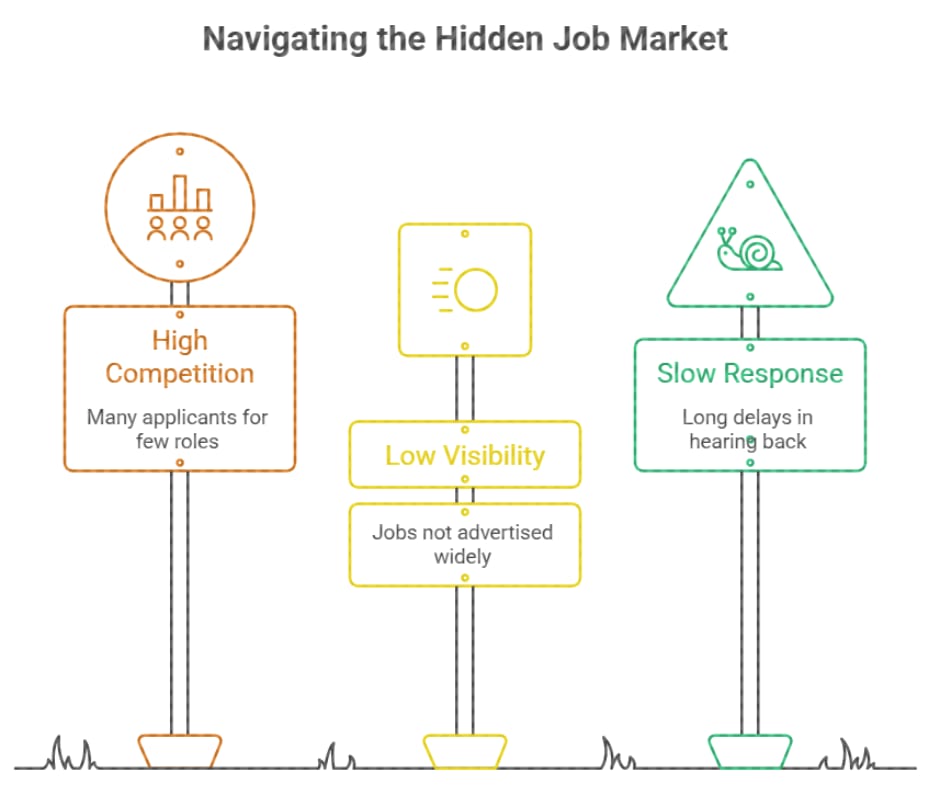
Estimates on exactly how big this hidden market is vary widely — some sources put it as high as 70 to 80%, while more conservative analysis pushes back on that specific number as overstated. What's consistently true across the data, regardless of which estimate you trust, is this: referrals make up only about 7% of all applicants, yet they account for 72% of interviews and 30 to 50% of actual job offers. Whatever you call it, that gap between effort and outcome is the entire reason this topic matters.
Why do companies hire this way in the first place
This isn't companies trying to make your life harder. It's companies trying to reduce risk and save money.
Posting a job publicly costs real money — job board fees, ATS software, and the hours spent screening hundreds of unqualified resumes
A trusted referral comes pre-vetted, which lowers the perceived risk of a bad hire
84% of companies worldwide now run formal employee referral programs, often with real financial incentives attached for the employee who makes the introduction
Referred hires tend to stick around longer too — 46% of referred hires stay beyond a year, compared to just 14% of hires sourced through traditional applications
From the employer's side, this isn't a flaw in the system. It's the system working exactly as designed.
Where these unposted jobs actually come from
Understanding the mechanics helps you know where to actually look:
Internal moves and promotions — internal moves account for roughly 21% of all hires, often opening up the role the promoted person leaves behind, sometimes before anyone outside the company even knows
Manager-initiated need — someone leaves, the team gets overwhelmed, and a manager starts asking colleagues, "Do we know anyone who could do this?" days or weeks before any formal posting goes up
Recruiter relationships — recruiters and staffing agencies frequently know about roles before they're posted, or even before they're fully created, because employers call them first specifically to avoid the public process
Proactive or speculative hiring — sometimes the right person reaching out at the right moment causes a company to create a role that didn't technically exist yet
Funding and growth signals — company funding rounds, expansion announcements, and leadership changes reliably precede hiring waves, often months in advance
How to actually access this market
Knowing it exists doesn't help unless you change how you spend your job-search hours. Here's what consistently works:
Build relationships before you need them. The biggest mistake job seekers make is starting to network only after they're desperate. Relationships built months in advance carry far more weight than a cold message sent the week you got laid off.
Target companies, not just job titles. Identify a focused list of employers you genuinely want to work for, then research their teams and reach out directly to people already there — not just whoever's listed as the recruiter.
Use informational interviews. A short, genuine conversation with someone in your target company keeps you visible even when there's no current opening. Cold outreach done thoughtfully is highly effective for accessing the hidden market, especially when you lead with curiosity instead of a direct ask.
Lean on alumni networks and professional associations. College alumni networks often carry unadvertised openings and mentorship connections that go significantly further than a cold message to a stranger, simply because there's already a shared starting point.
Optimize LinkedIn for discovery, not just applications. A complete profile with a clear, keyword-rich headline does real work here — recruiters and hiring managers are scanning LinkedIn for candidates long before a role ever gets formally posted.
Give before you ask. Share useful insights, make a helpful introduction, or offer your expertise without immediately attaching a job request to it. People remember who showed up with something to offer, and that's who gets the call when an opening appears.
Stay ready to move fast. Hidden opportunities don't sit around the way job board listings do. Keep your resume current and be prepared to respond within a day or two when someone in your network mentions an opening. Before sending it, make sure your resume still sounds like you. Overusing AI can make applications feel generic, so it's worth understanding when Should You Let AI Write Your Resume.
Why this actually pays off
This isn't about replacing job boards — it's about not relying on them exclusively while 70% or more of relevant opportunities move through completely different channels. Job seekers who actively network spend an average of 3.2 months unemployed, compared to 5.8 months for those relying primarily on online applications — nearly three months faster, just from changing where the effort goes.
The hidden job market isn't a shortcut, and it definitely isn't magic. It still rewards real qualifications and genuine relationship-building over time. But if you're spending all your energy refreshing job boards and sending applications into a void, you're only fighting for a fraction of what's actually out there — and the candidates who understand that are the ones getting hired while everyone else is still waiting for a callback.