Should You Let AI Write Your Resume? Here's the Honest Answer Nobody's Giving You
Published on July 14, 2026
Blogs
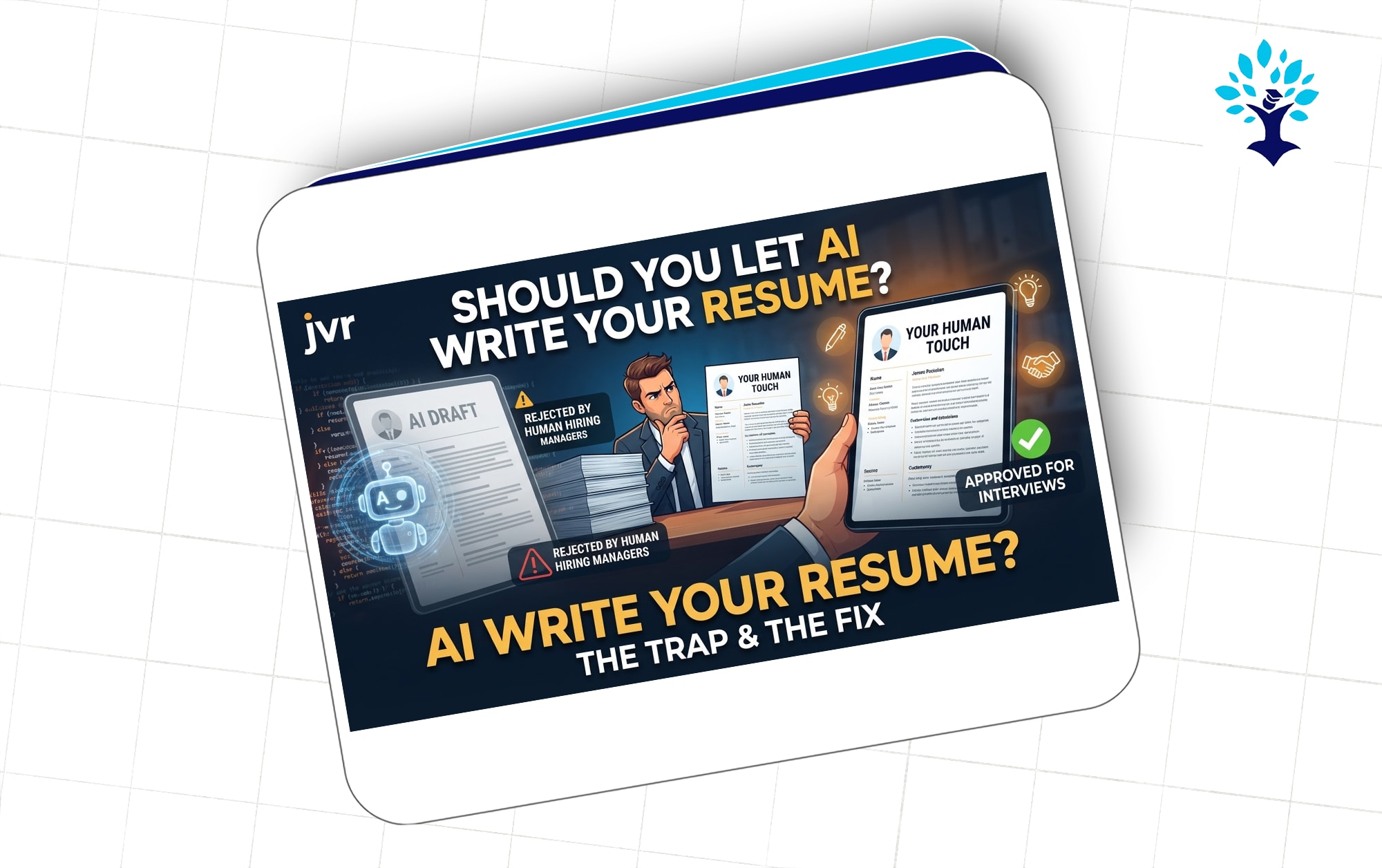
Here's the Honest Answer Nobody's Giving You
Everyone's doing it. Open any resume builder, scroll any job forum, read the comments under literally any LinkedIn post about job hunting, and someone's telling you to just dump your work history into ChatGPT and let it spit out a polished resume in ninety seconds. It sounds like a no-brainer, honestly. Why spend three hours wrestling with bullet points when software can do it in three minutes?
Except it's not quite that simple. And the people pretending it is are usually the ones who haven't actually been on the other side of a rejection they couldn't explain. Here's what AI resume tools genuinely do well, where they quietly work against you, and how to use them without falling into either trap.
The honest case for using AI on your resume
Let's start with what's actually true here, because the upside is real and not just hype dressed up as productivity advice.
It saves real time on the boring parts. Turning a messy, half-remembered work history into clean, structured bullet points used to eat an entire evening, usually a Sunday night you didn't want to lose. AI compresses that into minutes, which matters most when you're applying to several roles in the same week and your energy is running thin by application number twelve.
It's genuinely good at structure and keyword matching. The professional summary is the section AI tools handle best, and the section most humans write badly anyway — three tight lines of clear positioning is exactly the kind of compressed, formulaic writing AI is naturally built for.
It can actually improve your odds, not just your speed. A large randomized controlled trial involving nearly half a million job seekers found AI resume-writing assistance increased hires by 7.8%. That's not a marketing copy from a resume-builder website — that's a peer-reviewed result, and it's not a small number.
Almost everyone is already doing it, so you're not cutting some unique corner. 70% of job seekers now use AI tools to write resumes and cover letters, which means refusing to touch AI at all on principle isn't some moral high ground. It's just you doing more manual work for roughly the same result that everyone else is reaching faster.
It catches gaps you genuinely can't see in your own writing. You know your work better than any algorithm ever will, but you're also the worst-positioned person to notice when your own bullet points sound vague, repetitive, or quietly under-explained. A second pair of eyes, even a digital one, tends to catch that.
Where it quietly works against you
Now here's the part most "just use AI, who cares" advice conveniently leaves out, and it's the part that actually matters most.
The real problem isn't that AI writes badly. It's that it writes too smoothly, in a way that's started backfiring in a strange and specific direction. Recent academic testing found AI resume screeners now favor AI-polished resumes by margins as high as 82%, which means the software reading your resume first has developed an actual, measurable preference for writing that sounds like other software. That sounds like great news, right up until you remember a human being still makes the final call, and humans don't share that bias.
In fact, they're moving in the opposite direction, fast:
49% of US hiring managers automatically dismiss resumes they suspect were AI-generated, no second look given
62% of employers specifically reject AI-generated resumes that lack any real personalization
Recruiters skimming hundreds of resumes a week have quietly trained themselves to spot the same phrasing patterns, the same sentence rhythm, the same slightly-too-polished bullet structure showing up across a dozen applications in a single afternoon
That's the actual trap hiding in all of this. You optimize for the bot reading you first, and in doing so, you accidentally trigger suspicion in the human reading you second. With the majority of job seekers now leaning on AI to write resumes, recruiters have simply gotten good at spotting it, and "good at spotting it" tends to mean skeptical by default before they've read a single line of your experience.
There's a quieter cost too, one that never shows up in any survey or statistic. When AI writes your entire resume for you, you lose a strange but real kind of ownership over your own story. You stop being able to talk fluently about your own bullet points in an interview, because somewhere along the way, you stopped being the one who actually wrote them. That gap shows up almost instantly the moment an interviewer leans forward and says "walk me through this one" — and you're left explaining a sentence you didn't really craft, in your own words, on the spot, with no warning it was coming.
So what's the actual right answer?
Not "use AI for everything" and definitely not "avoid it entirely out of fear" — the real answer sits somewhere specific in between, and it's narrower than most advice on this topic is willing to admit.
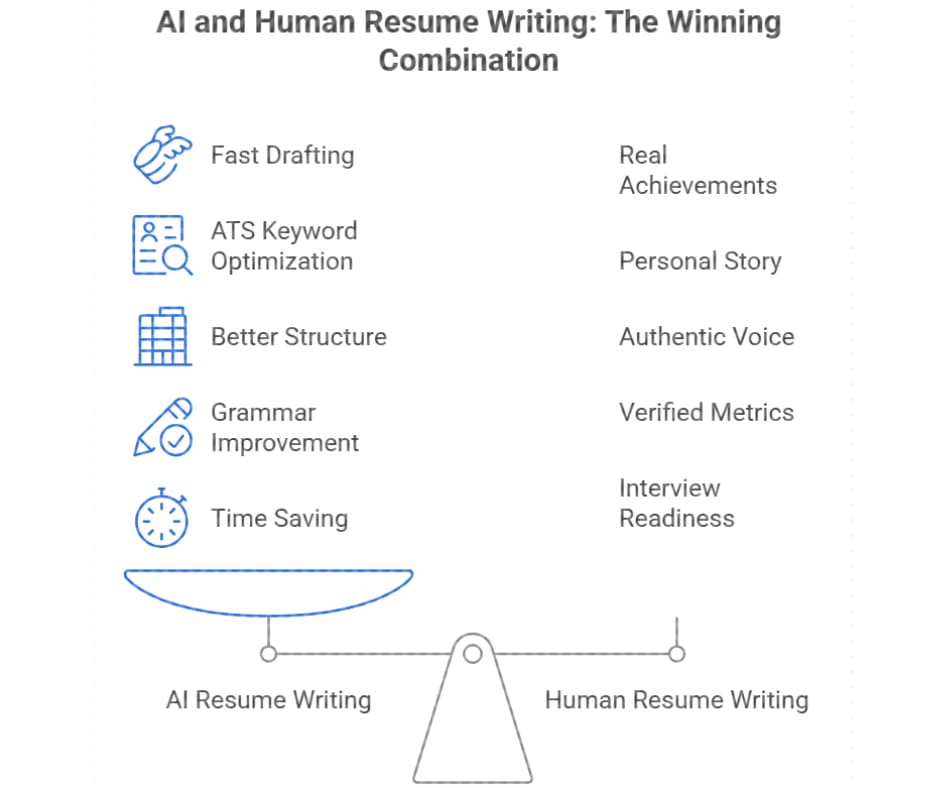
Let AI handle structure, not substance. Use it to organize a messy work history, suggest cleaner phrasing, and flag keyword gaps against a specific job description — not to invent accomplishments or guess at numbers you've never actually verified yourself.
Always rewrite the final version in your own hands. Take whatever AI generates as a first pass, then run it through your own voice. Vary the sentence rhythm. Add the one slightly odd, specific detail that only someone who actually lived through the project would think to include.
Keep every metric real, never AI-smoothed. If AI suggests "increased efficiency by 30%" and you genuinely don't know where that number came from, cut it. Recruiters can sense invented precision almost immediately, and interviewers asking one direct follow-up question will expose it even faster.
Use it for the summary specifically, not the entire document. This is the one section AI is genuinely strongest at — let it draft three or four versions, pick whichever lands closest to how you'd actually describe yourself, and then edit until it stops sounding like a template and starts sounding like you on a good day.
Run a final human-sense check before you ever hit send. Read the whole thing out loud, start to finish. If a sentence sounds like something you'd never actually say to a real person sitting across a table from you, rewrite it until it does.
The version that actually wins
The candidates landing interviews right now aren't the ones who avoided AI entirely on some point of principle, and they're not the ones who let it write the whole thing and walked away either. They're the ones using it as a drafting tool while keeping every specific detail, every real number, every slightly weird true thing about their own career unmistakably theirs. That's the entire difference between a resume that quietly impresses both the bot and the human reading it, and one that ends up satisfying neither.
Use AI to get to a faster draft. Just don't let it get to the final version before you do.