AI Is Now Running Your Interview Too — Here's What Every Job Seeker Needs to Know in 2026
Published on July 18, 2026
Blogs
What Every Job Seeker Needs to Know in 2026
Resume screening was just the beginning. By 2026, AI has worked its way into nearly every stage of hiring — not just deciding who gets a callback, but actually conducting interviews, scoring your face and voice, and flagging you as a risk before a human ever joins the call. Nearly 99% of hiring managers now use AI somewhere in the hiring process, yet most job seekers are still walking in prepared as if a person is judging every word.
That gap is costing people real opportunities. Here's what's actually changed, and how to navigate it without getting blindsided. That gap is costing people real opportunities. Here's what's actually changed, and how to navigate it without getting blindsided. If you're applying through public-sector recruitment as well, understanding the Government Job Portal can help you keep track of verified openings and recruitment updates instead of relying on scattered sources.
AI isn't just screening your resume anymore — it's interviewing you
This is the part that surprises people most. Around 63% of US job seekers have already been interviewed by AI, and that number jumped 13 percentage points in just six months. These interviews come in a few different forms, and knowing which one you're walking into actually matters:
Asynchronous video interviews — you record responses to pre-set questions alone, and AI scores your tone, word choice, facial expression, and pacing
Live AI copilots — used by some candidates during real interviews, listening in real time and suggesting answers
Hybrid systems — combining human interviewers with an AI scoring layer running underneath the conversation
None of this is hypothetical anymore. 67% of companies now use AI in recruiting, and platforms like HireVue and Greenhouse have quietly become standard infrastructure rather than a novelty.
A lot of candidates are quietly walking away — and it's not just discomfort
Here's a statistic that should reframe your perspective on this entire shift: nearly 4 in 10 job candidates have dropped out of a hiring round specifically because it required an AI interview. This isn't candidates who couldn't get an interview elsewhere, either — these withdrawals primarily stem from a lack of transparency about what the AI is actually measuring, combined with no visible human review anywhere in the process.
38% of US job seekers have withdrawn from a hiring process specifically because it involved AI evaluation
A separate 33% abandon processes that use AI-scored pre-recorded video with zero human review attached
75% of candidates want clear, legal disclosure of when AI is evaluating them — which is a fairly reasonable expectation, not an unusual demand
Only 8% of job seekers currently consider AI hiring processes to be fair
If you've felt uneasy talking to a screen instead of a person, you're not being overly sensitive. The discomfort is widely shared, and real numbers back it.
Candidates are fighting back with AI of their own
Here's where things get genuinely strange. A 2026 survey of active US job seekers found 22% are already using AI during real-time interviews, feeding themselves talking points or transcribed prompts while the interview happens live. One HR consultant put it bluntly to Newsweek: companies built this themselves by automating empathy out of hiring and pulling people out of the process over the past several years.
This has triggered a genuine arms race on the employer side:
Eye-movement tracking and gaze analysis now flag candidates referencing off-screen content
Dual-voice detection is used to catch proxy interviews, where someone is coaching a candidate live
Multiple face detection identifies impersonation attempts on camera
Take-home technical tests are declining specifically because AI makes it impossible to verify who actually did the work, pushing companies toward live coding sessions instead
Skills-based hiring is replacing the old "tell me about yourself" format
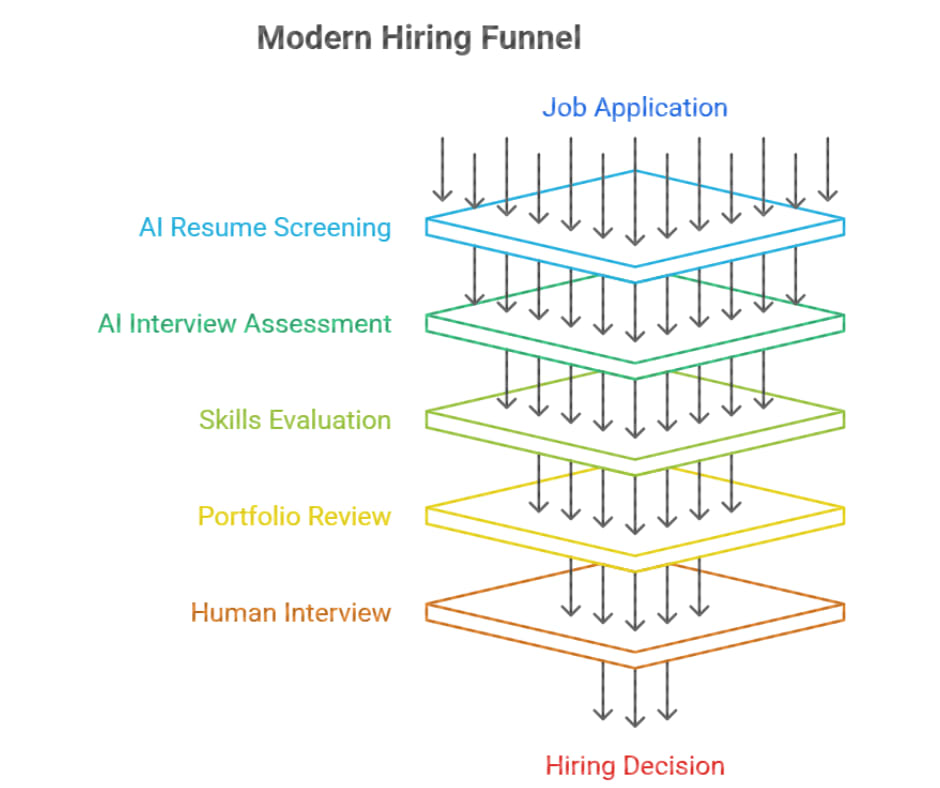
This shift is happening alongside the AI rollout, and it changes what you should actually prepare for. Companies are increasingly requesting work samples earlier in the process, sometimes right at the application stage, and building portfolio review directly into interviews. Instead of a generic behavioral question, you're more likely to hear something like "walk me through this project you built and what you'd change now."
Keep a current portfolio ready — GitHub profiles, case studies, writing samples, and design portfolios are becoming as important as the resume itself
Expect "job auditions" — paid or unpaid practical tryouts where you demonstrate actual capability instead of just talking about it
Prepare to show your thinking live, not just your final answer, since the goal now is watching how you reason through a problem in real time
Why this is actually a double-edged sword for you, not just employers
It's not all bad news buried under bad news. A field experiment found job seekers using algorithmic resume assistance were hired 8% more often, suggesting that AI, used thoughtfully on your side, too, genuinely helps rather than only working against you. And on bias specifically, blind screening that removes demographic cues has been shown to cut gender bias by 54% and improve underrepresented minority hiring by 35% when implemented properly.
The catch is that "properly" is doing a lot of work in that sentence. Only 26% of applicants currently trust AI to evaluate them fairly, and that distrust isn't irrational — plenty of companies have rushed AI screening into place without the human oversight that actually makes it fair.
What this actually means for how you prepare
Assume AI is involved at some stage, even if nobody tells you upfront — resume parsing, video scoring, or scheduling automation are now closer to the default than the exception
Don't rely on canned, generic answers — structured behavioral questions are becoming functionally outdated precisely because they're the easiest thing for AI tools to coach you through
Build a portfolio before you need one, not the week before an interview, since skills-based formats now show up earlier in the process than they used to
Ask directly when AI is being used to evaluate you — given that 75% of candidates already want this disclosed, asking isn't awkward, it's increasingly normal
Don't try to outsmart AI proctoring during live interviews — detection methods have gotten sophisticated enough that the risk of getting caught now outweighs whatever edge real-time prompting might offer
Practice explaining your actual reasoning out loud, not just reciting a polished answer, since more interviews now hinge on watching you think rather than what you say at the end
The honest bottom line
AI hasn't replaced human judgment in hiring, and most research suggests it isn't going to anytime soon. What's actually changed is where the first filter sits, and how much of the process happens before a person ever weighs in. Walking in prepared for that — portfolio ready, reasoning practiced out loud, comfortable enough to ask how you're being evaluated — is now part of the job search itself, not an optional extra.